You don't have a discipline problem. You have a blank page problem.
Every journal you've started, you've stopped. Not for lack of willpower — but because a blank page asks you to work out what to write on the days you've got the least left to give. This one hands you the way in.
What did you handle today that your past self would be proud of?
You've done this before. More than once.
You bought the beautiful notebook. It's still mostly empty.
You sit down to write and just… stare. Unsure where to start.
You manage three days, miss one, and never quite come back.
Your head is full — but the second you open a blank book, it goes quiet in the wrong way.
You know it would help. You just can't make it stick.
None of that means journaling isn't for you.
You didn't fail at journaling. The blank page failed you.
Starting a journal with an empty book is like being told to “just relax.” The instruction is the problem. A blank page gives you nothing to push against — no doorway in, no place to start. So on the hard days, the very ones where writing would help most, you close the book.
That's not a willpower failure. It's a design one — and it's fixable.
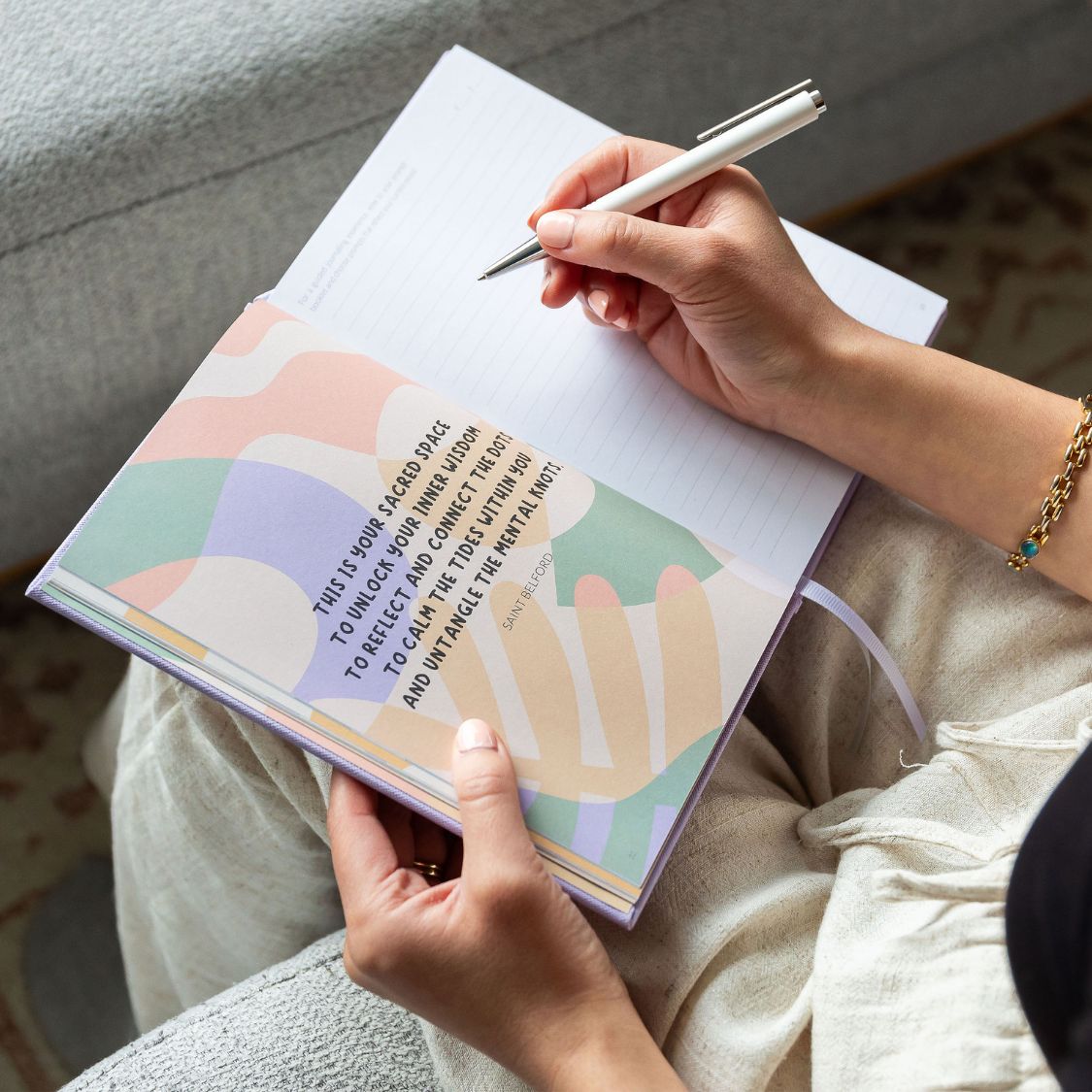
Everything you tried made sense. None of it gave you a way in.
Beautiful, and silent
It waits for you to do all the work — pick the topic, find the words, dig for the feeling. On a flat day, that's too much. So it stays empty.
Someone else's voice
Ten minutes of calm, then it's gone. Nothing left on a page that's yours — nothing to return to, reread, or watch yourself change across.
Three things, until it's rote
“Grateful for coffee, my dog, the sun.” It's a start, but there's no depth and no thread. It never asks the question underneath.
What's missing in each is the same thing — a prompt. A small, specific question that meets you exactly where you are.
The prompts live on cards — not printed on every page.
So you're never trapped by “assigned” space you have to fill. Draw a card when you want guidance. Write freely when you don't.
- 01100 therapeutic prompts, on a separate booklet.Choose one, reuse it, or set them aside — the blank pages are always yours too.
- 02Developed with the experts.Shaped with psychologists, certified coaches and mindfulness teachers — Rachael Kable, Elaine So, Bridget Murphy & Amy Kate Isaacs.
- 03Five gentle categories.Ease stress & anxiety, build self-worth, set intentions, find your values, reflect each month.
What did you handle today that your past self would be proud of?
Everything you need to stay well, in one bound book.
A few weeks in, this is what people tell us.
You keep going
The prompt removes the friction, so consistency stops depending on motivation.
Writing gets easy
“The first time I've been able to stay consistent” is the line we hear most.
Your head quiets
A real place to set things down means they stop circling at 11pm.
You get clearer
Values and priorities come into focus — and so do the decisions that follow.
You're kinder to yourself
The Self-Talk framework turns the inner critic into something gentler.
You build a record
A book of your own thinking you'll actually want to return to.
Why it sticks when the others didn't.
| Pledge to Stay Well | Blank notebook | Meditation app | Gratitude book | |
|---|---|---|---|---|
| Gives you a way to start | ✓ | — | ✓ | ✓ |
| Guidance and free space | ✓ | — | — | — |
| Something to return to | ✓ | ✓ | — | ✓ |
| Built with psychologists & coaches | ✓ | — | — | — |
| Reframes the inner critic | ✓ | — | — | — |
| Made to keep (faux leather, FSC paper) | ✓ | ~ | — | ~ |
The people who couldn't stick with journaling — until this.
I have often tried to start a journal, and it usually ends up mundane. This journal, along with the prompt cards, makes writing very easy.
The first time I have been able to stay consistent while journaling. Highly recommend!
This is very much the self care I didn't know I needed.
As someone new to journalling, the prompt cards are perfect to start you off on some soul searching.
Challenging your Inner Critic was the most empowering — it reminds you that ultimately you are in control of your own thoughts.
As a well-being consultant, they tick all of the boxes — and are stunning.
I love that there's space for free journalling as well as prompts, affirmations, values and breathing exercises. A great go-to for everything.
It's the best investment for mental health.
Designed by Alex & Tom and shipped from our Melbourne warehouse in 1–2 days. A journal that feels as considered as the work you'll do inside it.
Stop staring at the blank page.
Pick your colour. Open it tonight.
Before you start.
Is there a prompt on every page?+
No — and that's deliberate. The prompts live in a separate booklet so you can choose and reuse them without running out of “assigned” space. The lined pages stay open for free journalling, and there are 14 gratitude prompts tucked into the footers.
I've never journaled before — is this for me?+
Especially for you. The prompts are the on-ramp: a specific question to answer instead of a blank page to fill. It's the most common thing new journalers tell us — that this is the first one that finally stuck.
What do the prompts cover?+
Five categories: easing stress and anxiety, cultivating self-love and self-worth, setting meaningful goals and intentions, discovering your core values, and monthly reflection.
Is there a guide to help me use it?+
Yes — a complete how-to guide with video tutorials and bonus resources, free with your journal. You'll never have to wonder what to do with a section.
What are the specs?+
A5 (214×155×23mm), 208 pages (173 lined), premium faux-leather cover, 100gsm wood-free FSC-certified paper, two ribbon bookmarks. Four colourways: Lilac, Summer Sand, Coral Sunset, Forest Green.
The page won't fill itself. But it won't leave you stranded either.
A doorway in, a place to return to, and a book you'll actually keep going with.
Start your journal — $24.98 →

